Mermaid popularized diagram-as-code — flowcharts and sequence diagrams from fenced code blocks in your README. It's great, widely supported, and the right tool for a static chart. Markdystarts from the same idea (declare a diagram in text, keep it in version control) but adds the thing Mermaid doesn't do: it animates the diagram, revealing nodes and tracing labeled flows over a timeline.
Side by side
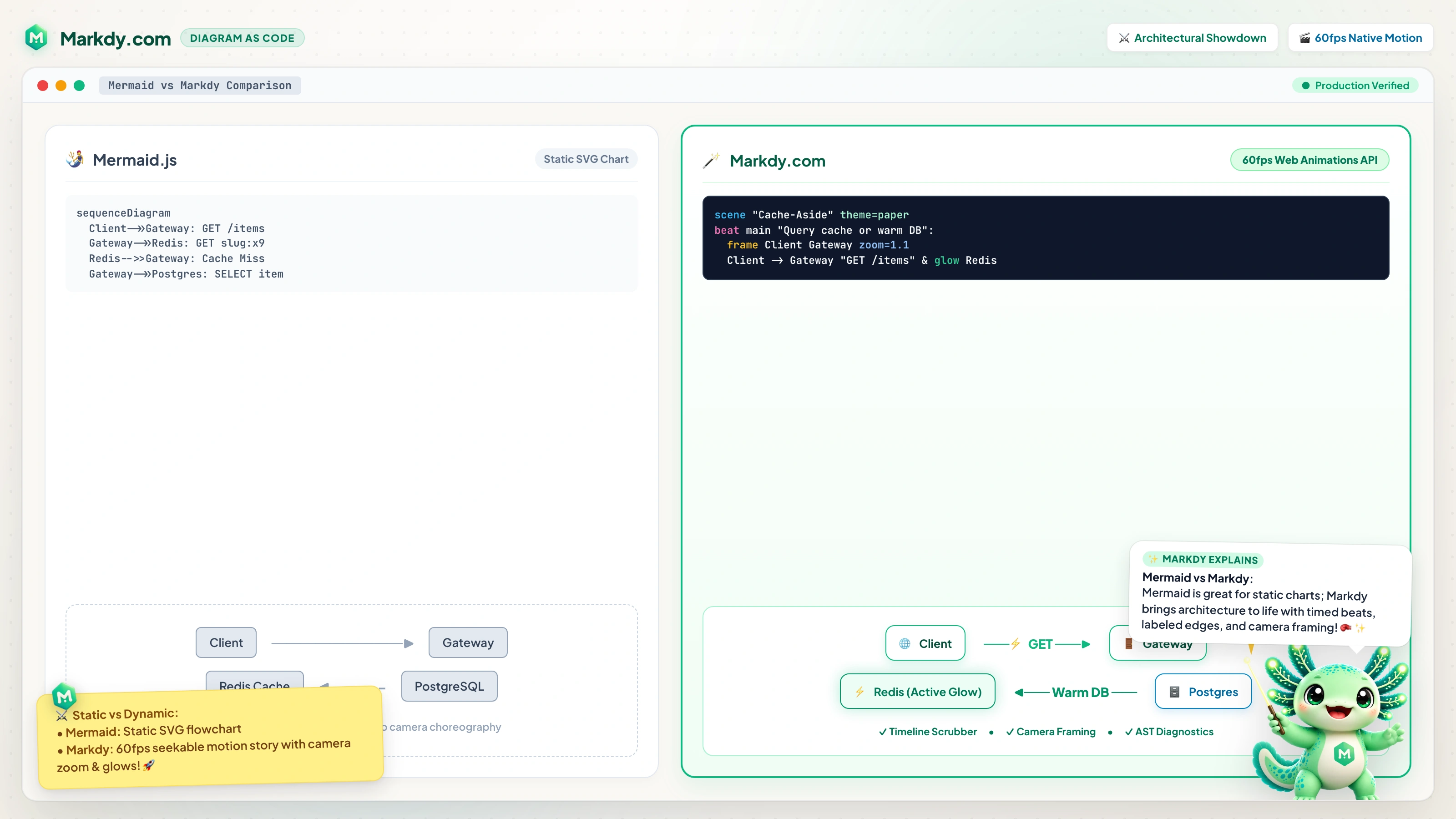
| Mermaid | Markdy | |
|---|---|---|
| Output | Static SVG chart | Animated, seekable scene |
| Best for | Flowcharts, static sequence/ER/Gantt | Architecture & system flows, narrated explainers |
| Motion / timeline | — | Beats, cues, labeled request/response/event edges |
| Auto-layout | Yes | Yes (+ orthogonal edge routing) |
| Lives in git | Yes | Yes |
| AI-friendly text DSL | Yes | Yes — diagram-native MarkdyScript |
| Runtime | SVG | Web Animations API + CSS (no Canvas/GSAP) |
The same idea, in each syntax
A request path in Mermaid is a static sequence:
sequenceDiagram
  autonumber
  Client->>Gateway: GET /items
  Gateway->>Redis: GET slug:x9
  Redis-->>Gateway: Cache Miss
  Gateway->>Postgres: SELECT item
  Postgres-->>Gateway: Row data
  Gateway-->>Client: 200 OK
The same flow in Markdy is a rich animated scene with timed beats and glow cues:
scene "Cache-Aside Architecture" theme=paper
layout LR

browser Client "Web Client"
gateway Gateway "API Gateway"
service Shortener "URL Service"
cache Redis "Redis Cluster"
database Postgres "PostgreSQL 16"

beat hit "1. Sub-2ms Cache Hit Path":
  show $nodes stagger=60ms
  frame Client Gateway Shortener Redis zoom=1.1
  Client -> Gateway "GET /x9" -> Shortener "resolve"
  Shortener -> Redis "GET slug:x9"
  Shortener <- Redis "200 Target URL"
  Client <- Gateway "301 Redirect"

beat miss "2. Cache Miss Fallback & Async Warm":
  frame Shortener Redis Postgres zoom=1.15
  Shortener -> Postgres "SELECT destination WHERE slug = 'x9'"
  Shortener <- Postgres "Row Found"
  Shortener ~> Redis "SETEX slug:url (Warm Cache)"
  glow Postgres color=#38bdf8 & glow Redis color=#22c55e
When to use which
- Use Mermaid for a static flowchart, ER diagram, or Gantt chart embedded in docs — especially where Mermaid rendering is already built in (GitHub, GitLab, many wikis).
- Use Markdy when the sequence is the point: walking a reader through an architecture, a cache-miss fallback, a deploy pipeline, or an onboarding flow with motion and emphasis.
They're not mutually exclusive — many teams keep Mermaid for quick static charts and reach for Markdy on the hero diagram of a launch post or an architecture review.
Looking specifically for a Mermaid alternative?
If you're here because Mermaid feels too static, read the best Mermaid alternative for animated diagrams, or see how the authoring model works inanimated diagrams as code. You can also try the exact examples above in the playground.